

A rechargeable scooter is delivered to the apartment. One of the employees requests a charging place in the office parking lot. A suggestion comes up to use the closest outlet until the charger gets installed.
It may seem like a minor change. However, it depends on many factors concerning the capacity of electricity of the building, state of its wiring, and safety of all the people living there.
Charging EVs requires as much caution as any other electrical installation. Prior to thinking about the place to install the charger, one should make sure the building is safe enough.
Safety Risks Beyond the Charging Area
Charging safety is not about the car only. A dependable charger connected to an incompatible power circuit does not solve the issue. Poor connections, worn-out insulation, and overload may create electrical risks. Cables laid on a pathway may cause people to trip.
Lithium-ion batteries also pose a risk. If damaged or faulty, such a battery may start the process of thermal runaway – an uncontrollable reaction creating high temperatures and passing from one cell to another. In case of a fault with the battery, dangerous gases can be released and reignition may occur.
When dealing with smaller electric cars with interchangeable batteries, charging close to a corridor or a staircase may put an incident in close proximity to the escape route. The London Fire Brigade gives guidelines on assessing the risks of battery charging in relation to building layout and occupancy.
The impact is not limited to the occupants but includes neighbours, cleaners, delivery men and women, and even the security guards. Those who do not use the charger at all may still be at risk.
Is the Building Fit for Purpose?
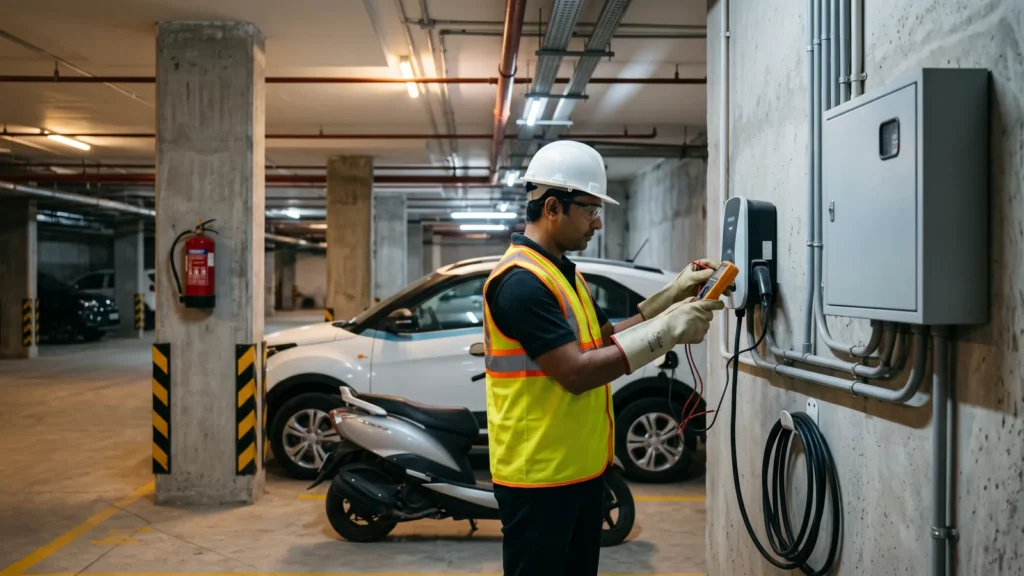
The starting point here should be an assessment carried out by a qualified electrical engineer. Get the engineer to look into the current sanctioned load, distribution boards, cabling capacity, earthing and protective devices. Discuss if any extra demand calls for load increase or interaction with the electricity distribution company.
A system that works for one car needs modifications before a few residents or employees start charging at the same time. Planning for future needs prevents improvisations all the time.
Get the engineer to translate the report in simple terms.
- What defects must be corrected before charging is started?
- How much capacity will be left for other cars?
- Who will bear the cost of any upgrade to be done for shared use?
A written report enables action to be taken, rather than an oral explanation that things should be fine for the time being.
As important as the above is the site itself. Take care of water logging, movement of vehicles, accessibility for maintenance and proximity to flammable material storage. Make sure charging sites are kept away from exits and passageways.
Proper consideration should be given to fire safety measures when making plans for basements. You can find out what is needed from the local fire authority before installing. Convenience for parking does not necessarily mean suitability for charging purposes.
Safer Installation Practices
Start with a design plan and use an installer who is experienced with EV charger installations. Ensure that you have documentation to prove compliance with Indian standards for the charger installation in question.
The NITI Aayog guidelines for EV charging infrastructure installations refer to the need for dedicated circuits, overcurrent protection, residual current protection and protective earthing. All this equipment needs professional specification and testing. It would be impossible to achieve all forms of protection through using only one circuit breaker.
Do not resort to jury-rigging, multi-plug boards and ad hoc installation practices. Ensure that the charger is installed in such a way that it is accessible using the planned cable.
Control measures are needed for the work itself. Electrical supplies must be isolated safely; access to the work area must be restricted; and occupants or employees must be protected from live electrical wiring and tools. No one should have to do work on live equipment just to keep the office operational.
Before any handover is completed, ensure that you have all of the relevant test data, operational information, and maintenance schedule for the equipment. Determine who is authorized to isolate the equipment; who will receive fault notifications; and who authorizes repairs.
Reasons Why the Government Took Action
In response to reports of EV fires, the government formed an expert committee for evaluating battery safety, leading to higher standards set under AIS 156 and AIS 038 for relevant vehicle types. These standards cover aspects such as batteries, BMS, chargers, and resistance to thermal propagation.
The aim of this action was to enhance safety during production and testing. Building owners would need to take care of the installation and usage dangers separately.
September 2024 Ministry of Power charging infrastructure guidelines apply to private garages, housing societies, offices, and public places. They aim for a higher level of safety and reliability, greater clarity of roles, and improved readiness of power systems.
The installation of a charging station is a delicensed activity under these guidelines. This does not mean there will be no need for compliance with electrical, construction, and fire safety regulations. The difference becomes significant when one believes that purchase of a charger alone is enough.
Government, Local Authorities & Emergency Services
It is shared responsibility among the authorities, depending upon certain procedures that depend upon the place and installation.
The Central Electricity Authority formulates the electricity safety regulations. Distribution agencies take care of electricity installations and the connection process. The state electricity inspectorate carries out their inspection and safety activities.
Local authorities, including municipal corporations and municipalities among others, integrate charging in their building permissions, parking installations and local development plans through the policies that they adopt. The 2024 guidelines also incorporate State Nodal Agencies and Municipal Commissioners assessing the charging demand potential every year.
The Ministry of Housing and Urban Affairs incorporated EV regulations in the Model Building Bye-Laws. But model regulations should not be seen as identical regulations that apply universally. Owners need to find out what their state and local government agencies have decided to adopt.
The fire and rescue services give recommendations about fire precautions and approval for them and perform fire fighting operations. Police can help in case of incidents involving public safety, access management, traffic and investigation if necessary. They cannot act as electricians or approve charging station design.
As for the property managers, the real work for them is to establish the authorities in question at an early stage.
Customer and Business Responsibilities
The customer must adhere to the instructions provided by the vehicle manufacturer for charging and ensure that the appropriate equipment is used. Do not continue to use damaged chargers or cables. Report defects immediately and seek a diagnosis by an authorized service provider if there is damage to the vehicle or the battery.
Safety is also dependent on good manners. Park in the appropriate space, store cables correctly and ensure that pathways remain clear. Report a defect even if the charger is not your own.
Charging safety should have a responsible person designated within businesses. Facilities departments should have an inspection procedure, repair funding and procedures for removing malfunctioning equipment from service. Staff should know how to report recurring tripping rather than resetting the protection device.
Housing associations should reach agreement on installation authority, maintenance liability and electricity charges before problems arise. The contractor should be upfront about constraints. The attractive low quote loses its attractiveness when essential protection and testing have been overlooked.
Protecting People When Something Is Wrong
Smoke, hissing, leakages, or a chemical odor in and around the battery or automobile indicates the need to evacuate the area and inform others. Don’t go near to identify whether there is an issue with the battery.
Sound the alert, evacuate from a safe path, and call 112 in case of an emergency in India. Provide the address of the building, location of the battery charger, and any details on individuals requiring help. Don’t attempt to extinguish a traction battery fire or handle a smoking battery.
An emergency isolation control is to be used only if it can be accessed safely without coming close to the hazard. Disconnection of external power sources does not mean eliminating the energy that has been stored in the battery.
Emergency planning needs to consider kids, elderly individuals, and those with disabilities. The security personnel should have adequate training rather than depending on their improvisation abilities to come up with a rescue plan.
Impact of Charging Safely on the Society
The effect of a faulty charger is not limited only to one single parking spot. The residents might be denied entry to their residence. A local business establishment might get closed for repairs. Employees might incur loss of wages while the families bear medical expenses and uncertainties.
Inadequate planning for the charging can result in conflicts in relation to the cost-sharing for electricity, parking, and maintenance charges.
If facilities are well-managed, they can generate confidence. People feel safe to charge their devices if they have well-maintained equipment, and faults are attended to, and roles and responsibilities are known.
Access should be considered too. Tenants, apartment dwellers, and employees require not only access to safe facilities but also clear safety instructions. The availability of instructions in common languages, easy layout and complaints mechanisms allows people to become part of the community.
Conclusion: Preparedness Begins with Preparedness
For a structure to be considered fit for the purpose of EV charging, there is a need for an assessment of the electrical installations, parking, maintenance services, and emergency preparedness. The installation of equipment is just a portion of that responsibility.
With Petrotech Safety Solutions, the call is simple: hazard identification, competent personnel, and making safety a daily choice. Request the assessment. Get the job done. Provide the residents and staff with instructions they can follow.
An impaired vehicle can be replaced. The loved one will not come back home. When India prepares to accommodate its electric mobility, all decisions made while charging must consider the safety of those around the process. There is no better progress than all getting back home safely.
References
- NITI Aayog, Handbook for Electric Vehicle Charging Infrastructure Implementation (Version 1): https://niti.gov.in/sites/default/files/2023-02/EV_Handbook_Final_14Oct.pdf
- Ministry of Power, Government of India, 17 September 2024, Guidelines for Installation and Operation of Electric Vehicle Charging Infrastructure-2024: https://beeindia.gov.in/WriteReadData/L45218/2841453721548450.pdf
- London Fire Brigade, #ChargeSafe: guidance for responsible persons on charging and storing e-bikes and e-scooters: https://www.london-fire.gov.uk/safety/lithium-batteries/chargesafe-guidance-for-responsible-persons/
- Press Information Bureau, Ministry of Housing and Urban Affairs, Model Building Byelaws 2016 and URDPFI Guidelines 2014 amended for establishing EV charging infrastructure: https://www.pib.gov.in/PressReleasePage.aspx?PRID=1564744